20ft vs 40ft Shipping Container — Dimensions, Cost & Which to Choose
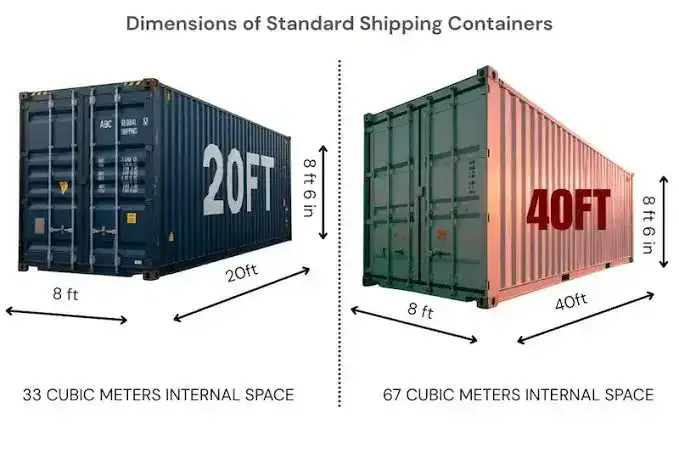
Trying to decide between a 20ft vs 40ft shipping container? You’re not alone — this is the single most common question we get from customers across Tennessee. Moreover, the right choice depends on three factors: how much space you actually need, where you’ll position the unit, and your budget. Furthermore, this guide breaks down the real shipping container dimensions 20ft vs 40ft, current pricing, and exactly who each size is right for.
20ft vs 40ft Shipping Container Dimensions — Side by Side
Here is the complete dimensional comparison:
| Feature | 20ft Container | 40ft Container |
|---|---|---|
| External Length | 20ft (6,058 mm) | 40ft (12,192 mm) |
| External Width | 8ft (2,438 mm) | 8ft (2,438 mm) |
| External Height (Standard) | 8ft 6in | 8ft 6in |
| External Height (High Cube) | 9ft 6in | 9ft 6in |
| Internal Length | 19ft 3in | 39ft 5in |
| Internal Width | 7ft 8in | 7ft 8in |
| Capacity (Standard) | 1,170 cu ft | 2,390 cu ft |
| Capacity (High Cube) | 1,335 cu ft | 2,694 cu ft |
| Floor Footprint | 160 sq ft | 320 sq ft |
| Tare Weight | ~5,000 lbs | ~8,200 lbs |
As you can see, a 40ft container is not simply “bigger” — it provides exactly double the length and capacity of a 20ft unit, while keeping the same width and height. Consequently, the choice often comes down to footprint rather than just volume.
20ft vs 40ft Shipping Container — Cost Comparison
Pricing is where most buyers start. Therefore, here’s how our current Tennessee inventory compares:
| Container | Price | Capacity | Price Per Cu Ft |
|---|---|---|---|
| Used 20ft Grade A | From $2,100 | 1,335 cu ft | ~$1.57 |
| 20ft One Trip High Cube | From $2,200 | 1,335 cu ft | ~$1.65 |
| Used 40ft Container | On request | 2,390 cu ft | Lower per cu ft |
| 40ft High Cube One Trip | On request | 2,694 cu ft | Lower per cu ft |
In fact, 40ft containers almost always deliver a lower cost per cubic foot than 20ft units — because manufacturing and shipping costs don’t scale linearly with size. Therefore, if maximum storage value is your priority and you have the space, the 40ft option is typically the better deal per square foot.
Cost of Renting 20ft vs 40ft Shipping Container
If you’re comparing renting a 20ft vs 40ft shipping container instead of buying outright, the same value principle applies — a 40ft rental typically costs less per cubic foot of storage than a 20ft equivalent. However, rental costs add up significantly over time. For example, a $100–$150/month rental adds up to $1,200–$1,800 per year — often exceeding the outright purchase price of a used 20ft container within just 12–18 months. Consequently, for storage needs longer than a year, buying is almost always the more economical choice. Contact us for current pricing comparisons on both options.
Which Size Is More Common — 20ft or 40ft?
According to the World Shipping Council, the global container fleet is split fairly evenly between 20ft and 40ft equivalent units, with 40ft and 40ft High Cube containers representing the larger share of active freight capacity worldwide. In the used and one trip container resale market specifically, however, 20ft units tend to be more readily available — largely because they’re easier and cheaper to reposition for resale, and fit a wider range of residential and small business sites.
20ft vs 40ft Shipping Container — Which Should You Choose?
Here’s a practical breakdown based on the most common use cases we see across Tennessee:
Choose 20ft If:
- Your site has limited space — driveways, tight backyards, or urban lots
- You need storage for a single-car-garage equivalent of items
- You’re building a compact container home or studio
- Delivery access to your property is restricted
- Budget is the primary constraint — entry pricing starts from $2,100
Choose 40ft If:
- You need maximum storage capacity — construction sites, commercial inventory, large equipment
- You have ample space for a 320 sq ft footprint
- You want the lowest possible cost per cubic foot
- You’re building a full-size container home with a proper one-bedroom layout
- You need drive-through access or full side access — both are more common configurations in 40ft
Can’t Decide? Consider a 30ft Container
If neither size feels exactly right, our 30ft One Trip container offers a genuine middle ground — approximately 1,780 cubic feet, roughly 52% more capacity than a 20ft unit, without the full 40ft footprint.
Frequently Asked Questions
What are the dimensions of a 20ft vs 40ft shipping container?
A 20ft container measures 20ft long × 8ft wide, with 1,170–1,335 cubic feet of capacity depending on height. A 40ft container measures 40ft long × 8ft wide, with exactly double the internal length and 2,390–2,694 cubic feet of capacity.
Is a 40ft container cheaper per cubic foot than a 20ft container?
Yes, typically. A 40ft container almost always offers a lower price per cubic foot than an equivalent 20ft unit, since fixed manufacturing and transport costs don’t scale linearly with container length.
What is the most common shipping container size?
Both 20ft and 40ft containers are extremely common globally, with 40ft and 40ft High Cube units representing the larger share of active international freight capacity. For used and one trip resale purposes in the USA, 20ft units tend to be more widely available for residential and small business buyers.
Is it cheaper to rent or buy a 20ft vs 40ft container?
For storage needs longer than about 12–18 months, buying is almost always more economical than renting — regardless of size — since rental costs accumulate while a purchased container retains resale value. Contact us for current pricing on both options.
Browse Our Full Range
Ready to choose? Compare current pricing and availability across our full container range.